
Twenty-Two Days In
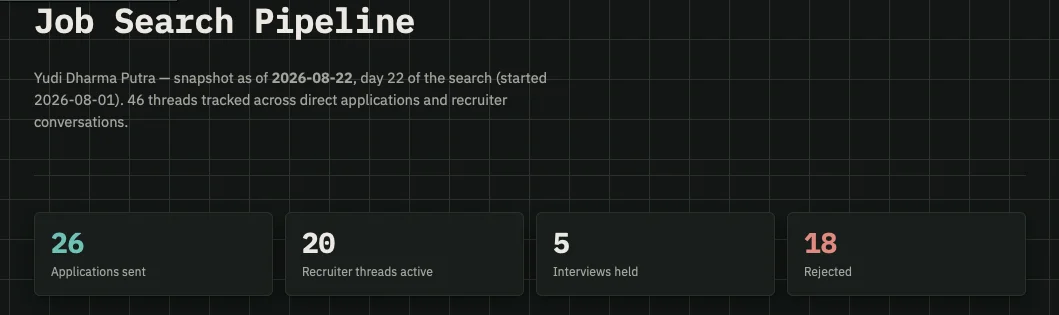
I started this search on August 1st. Here is where it stood on day twenty-two: 26 applications sent, 20 recruiter conversations still alive, 5 interviews held, and 18 rejections — most of them at document screening, before anyone had a conversation with me.
I am writing this down partly because I wish someone had written it for me the first time. Back in May I wrote about the five-month search that ended at a startup — that post was mostly about how it felt. This one is the other half: where the applications actually go, which channels produce replies, and what I would tell a foreign engineer starting from zero in Tokyo.
Everything here is one person's experience. Twenty-six applications is not a dataset. But it is honest, and it is current.
Being Here Already Is a Bigger Advantage Than People Admit
If you are applying from outside Japan, you are not just competing on skill. You are asking a company to sponsor a Certificate of Eligibility, wait for immigration to process it, and hold a seat open for months while you convert that into a work visa — usually the Engineer/Specialist in Humanities status, or Highly Skilled Professional if your points add up — and then sort out a flight, an apartment, and a bank account that will probably refuse you at least once.
Plenty of companies will do that. But when a hiring manager needs someone in the next six weeks, "already in Tokyo, can start immediately" is not a small line on a résumé — it removes an entire category of risk from their side of the table. I did not fully appreciate this until I was the one holding that advantage.
If you are overseas and set on Japan, budget those extra months into your plan rather than treating them as a delay. The timeline is not you being slow.
Japanese Opens Doors; English Keeps Some of Them Open
Being able to work in Japanese changes the size of the funnel, not just the quality of it. With business-level Japanese and a JLPT certification, most of the market is available to you. Without it, you are choosing from a real but much smaller slice.
The certificate matters more than I expected — not because N2 proves you can run a design review in Japanese, but because it is the one signal a screener can act on in five seconds. It gets you past the filter; the interview is where you actually prove it.
And English-speaking environments genuinely exist here. My previous team ran in English while I spoke Japanese with business stakeholders. That combination is common in Tokyo, and it is worth targeting deliberately rather than assuming you need to be fluent before you are allowed to apply.
Where the Jobs Actually Are: Five Channels for Foreign Engineers
Five channels, and they behave very differently.
Direct on company websites. Most Japanese companies run their hiring through portals like HERP or HRMOS. Convenient for them, brutal for you: your résumé passes through applicant tracking before a human sees it, and a lot of applications end right there. Rejected in three days without a single conversation is not a verdict on your ability — it usually means your document did not match a keyword filter.
LinkedIn. Worth investing in the profile before you need it. Once it is good, the traffic reverses: recruiters and in-house talent acquisition come to you. It is also where both foreigner-friendly Japanese companies and the Japan offices of global companies post their openings.
TokyoDev and Japan Dev. Built for exactly this situation. Listings state their Japanese requirement up front — conversational, or none at all — which saves you the exhausting guesswork of decoding a job description to find out whether you are even eligible.
Wantedly. Heavily Japanese-domestic, and for a foreign applicant most roles here will expect Japanese communication. Like LinkedIn, a well-built profile gets you scouted rather than applying.
Recruiters and agents. The one that has worked best for me. A recruiter with a real relationship at a company will walk your résumé to HR directly — which means you skip the applicant tracking entirely and get read by a person. That single difference has produced more interviews for me than every cold application combined.
What Actually Worked: Recruiters vs. Cold Applications
Cold applications produced most of my 18 rejections. Recruiter introductions produced most of my 5 interviews.
I do not think this means cold applying is worthless — it costs little and occasionally lands. But the return per hour is very different, and I have shifted my time accordingly: fewer applications, more conversations.
I have tracked every thread since day one — applied, scouted, rejected, interviewing, passed — in Obsidian, wired up to Claude so I can ask questions of my own pipeline instead of scrolling a spreadsheet. Which channel converts. Where things stall. Which conversations have gone quiet long enough to be worth a follow-up. If you take one tactical thing from this post: write it all down from the first day, not the day you realise you should have.
Why I Ask for a Casual Chat First
Some companies build a casual, no-evaluation conversation into their process before the formal rounds; others treat it as optional. I ask for one whenever I can, and not because it is the easy stage.
Seven years in, I have stopped optimising for the job I can just barely get. What I am looking for now is an environment where I keep getting better — because the gap between a team that invests in that and one that quietly does not is the difference between a good two years and a wasted one. A casual conversation is the only stage designed to tell you which one you are looking at: what the team actually values, who you would sit next to, whether "we support growth" means something concrete or is just a line on the careers page.
It runs in both directions. It is also the one stage where you can show motivation as a person rather than as a document — no whiteboard, no time limit, just whether the two of you want to build the same thing.
Still Going
Day twenty-two, and I do not know how this one ends yet. Last time it took five months. Maybe this search is shorter; maybe it is not.
But I know the map better than I did in December, and that felt worth writing down while I am still in the middle of it — before hindsight tidies it into a story neater than the truth.
If you are going through the same thing, or you have already been through it and learned something I have not, let's connect on LinkedIn or Wantedly. I would rather swap notes than guess.