
It's Over
On September 25th I accepted an offer. I start in October.
A month ago I wrote a post from day twenty-two and ended it with "I do not know how this one ends yet." Now I know, so this is the other half: the full numbers, and what they say that I couldn't see from the middle.
This was my second search this year. In May I wrote about joining a startup after five months of looking. It turned out not to be the right fit, and by August I was searching again.
The Whole Funnel
Here's the search in one line: 60 applications → 18 interviews → 4 offers → 1 yes.
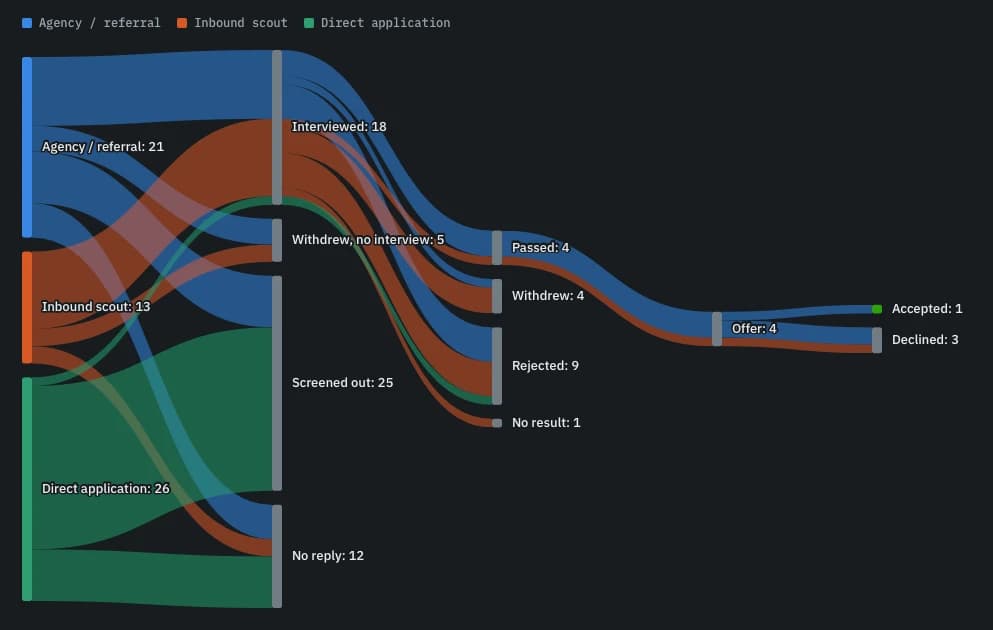
The diagram shows every thread I tracked. A few things stood out once I put it all in one picture.
Direct applications almost never became conversations. I sent 26 cold applications through company portals. Nearly all of them ended at document screening or got no reply at all. Only a thin green line makes it to the interview column.
Agencies and scouts did almost all the work. Referrals and inbound scouts made up 34 of the 60, and they produced almost every interview and every offer. When someone who knows the company carries your résumé to a person, you skip the keyword filter. In August I thought this was a pattern. Now I'm sure of it.
I said no more than I expected to. Four offers, three declined. Some of that was timing, and some was that my criteria changed partway through (more on that below). Nine rejections after interviews hurt less than I thought they would, because I was also turning things down.
Most of the Effort Went in Early
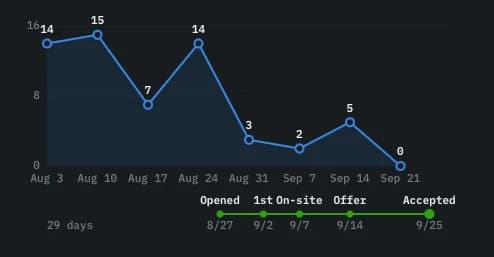
Fifty of the sixty applications went out in the first four weeks. After that it dropped to a trickle, because I had more interviews than I could prepare for properly.
The funny part is that the offer I accepted wasn't one of the early ones. It opened on August 27th, after my busiest weeks were over, and went from first contact to signed in 29 days: first interview, on-site, offer, done. All that volume in August didn't produce the result directly. What it produced was practice, so by the time the right conversation showed up I was sharp enough not to waste it.
The Question I Stopped Asking
At the start I was optimizing for growth: the hardest problems, the strongest engineers to learn from, the most impressive name. About five weeks in I realized I was interviewing for a version of the job I didn't actually want.
What I wanted, once I was honest about it, was simpler: work I'd still enjoy in a year, a sane balance with the rest of my life, and a stable income. That changed which offers looked good. A couple of processes that looked like my best chances on paper stopped fitting, and I withdrew from them. It felt like throwing away progress. Looking back, it was the most useful decision of the whole search.
If you're in the middle of this: check what you're optimizing for about halfway through. It may have changed without you noticing.
Things I'd Tell Myself on Day One
- Talk to people instead of mass-applying. One recruiter who actually knows the company is worth ten cold applications.
- Track everything from the first day. Every number in this post comes from notes I kept as I went. Without them I would have remembered it as "lots of rejections," and that wouldn't have been true.
- Live coding is its own skill. I froze on an algorithm question in one round and did well on an AI-assisted coding test in another. Same engineer, different format. Practise the format, not just the fundamentals.
- A rejection is information, not a verdict. Twenty-five screen-outs mostly told me which channels to drop, not how good I am.
What's Next
In October I start as a web application engineer at a product company in Tokyo. I'll write about it once I've actually shipped something there.
Thanks to everyone who took a call, passed my résumé along, or sat across from me in an interview, including the ones who said no. If you're in your own search and want to compare notes, find me on LinkedIn.